Showing posts with label app idea. Show all posts

Friday, August 22, 2014

Augmenting History: Riffing on Augmented Reality Pt. 3

...This is a continuation of the 'Augmenting History' posting I stared a few weeks back and is the final entry (3 of 3)

This entry covers some ideas on monetization.

AR Applied to Sporting Events


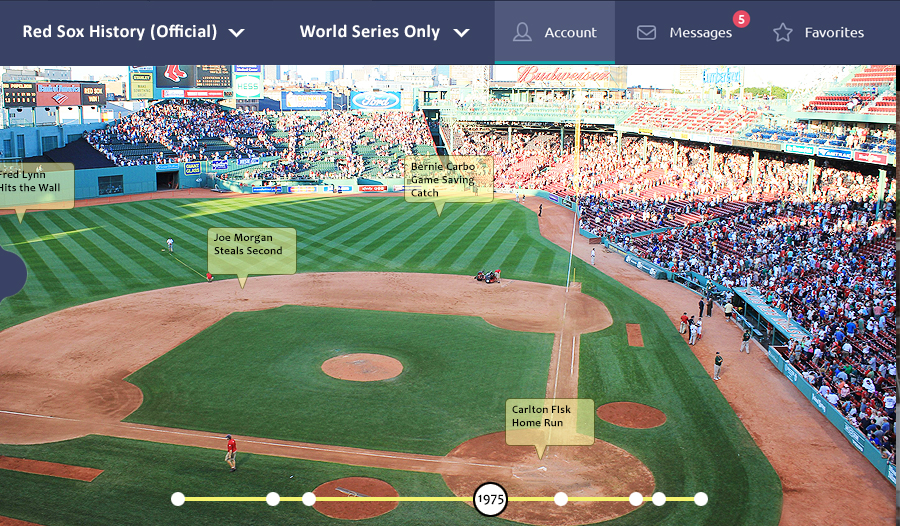
fenway.jpg
View of the mobile client

While users are waiting for sporting events to begin they could purchase and download official datasets from their favorite teams. They may be able to view the datasets by date or big game.

It would also be possible to ‘Augment stats’- that is, users could advance through the game they are currently watching, inning by inning or quarter by quarter and see the big plays or track trends in where the action is occurring on the field.

Monetization


Generally speaking, the app and tools should be free to help catalyze rapid adoption.

There are a number of angles in which the platform could be monetized including some of the following ideas:

Sponsorship - A session or a dataset would be sponsored by a company for a fee
Paid Premium Content Creation Feature Set - Premium Content Creators (e.g. Official Boston Red Sox) would pay a yearly subscription fee for access to premium features in the content editor. This would make them ‘official’ creators of premium content for the platform. The datasets would look more polished and may be more interactive because of the enhanced feature set they would be using for creation and editing.
Banner Ads - Banner ads would be served in the app - the user could ‘turn them off’ for a small fee
Paid Download of Premium Feature Sets - The ‘Official Gettysburg Data Set from the National Parks Dept. would be available for a small fee.

Note- At first blush the sponsorship model seems the least attractive of these ideas. In order to support the deployment of such a system, alot of support in terms of infrastructure, business relationships and sales would be needed.

Socialization and Datasets


There would be two classes of datasets ‘Free’ and ‘Premium’. Premium datasets are vetted and created by professionals and available for purchase while free datasets can be created by anyone.

Users will have the ability to ‘vote’ and rate data sets (ala Yelp or really any customer review-based app) and filter and search for relevant datasets via their mobile client.

When loading datasets users could filter out lower rated datasets.


Wednesday, April 16, 2014

iOS Game: Hard Rippin' Santa

Intro


HeeeHaaaww!!! You know what mamma always said, “If you're going to rip them hard! Rip them Loud!”

Santa is coming to town and he is delivering more than just Christmas presents! Work your way up through the levels of this mad capped, gas-passing adventure and see if you can score the ultimate deployment and peel the wallpaper off of Little Jimmy's walls!

The more our little animated friend eats, the more gassy he becomes and the more likely he is to deploy the ultimate payload that will leave Little Jimmy's house in disarray...and a little stinky. But be careful, don't feed him anything that is likely to settle his stomach or the opportunity to pass some gas may pass you!

It's mad rippin' fun!

Available in the App Store: here

General Info - Feeding Santa

A 3d Santa stands on a 'set' a 'ready, set go!' appears- the counter begins to count down from 1 minute.
In one minute the user 'feeds Santa as much food as possible trying to increase his 'indigestion' shown
on an indigestion meter.
The user moves Santa across the screen (left to right) and tries to catch the proper food sources as they
'fall from the sky'- while trying to avoid negative 'food sources' that will relieve his indigestion. ex.
Chili Dogs are worth extra points as antacids are worth negative points.
As Santa collect/eats each food kind a score/number will float up accompanied by a sound effect. The
converse being true for negative items.
Some more valuable items may have particle trails (e.g. flames falling off the chili dog)
The avatar can be moved across screen by whatever means seem to be the most fun – maybe Santa
'sticks' to the users finger or there are directional arrows or we use the gyro.
At the end of the minute the user has accrued a score and Santa is either

Design Samples


Thursday, February 13, 2014

App Idea: LocalNation: Consolidating Community Communication


This is an idea from a while back, I s'pose most of what is here could be achieved using existing social/broadcasting apps IF we could somehow get towns and cities to effectively streamline and share their information across agencies.

Loclnation is inspired by the idea that people at local levels around the world have the need to share information more effectively. While some of this 'local information' is available through a variety of sources, some of it is not. Loclnation will 'aggregate' all of a user's local info into one app. The app will update automatically which will prevent the user from having to check multiple sources to get their local news and information.

Some of this information is also on local websites and bulletin boards but, again, the user, in almost all cases would need to check multiple sources. The app is free and easy to use which lowers its barrier to adoption.

Loclnation looks to inspire people to use technology to communicate and revolutionize the way they interact with one another.

The main thrust of the idea centers on a mobile framework that users can upload content to. The content is then relayed to the front end app/reader.

The Mobile App


The mobile app is downloaded for free, like many other apps. A user either enters their current zip code to retrieve data or the device's geo location will be used.

  • It is available on both iOS and Android
  • It is/has portrait mode only
  • It auto updates
  • When updates are present the app indicates this

New updates are always organized to the top of categories (bulletin board) and announcements that have already been viewed are grayed out.


The Framework

At its core it is a base mobile framework to which users can add content pertinent to their locale. It will be built and deployed in a number of tiers, Base, I and II. These tiers represent different levels of monetization and may possible represent phases of implementation.

Base

  • Police
  •   Fire
  •  Announcements
  • Town/City Business
  • Schools
  • Churches

Once a town or city adopts the framework they will be encouraged to 'advertise' it. This can be easily achieved by posting on town websites, bulletin boards and/or sending home announcements with school children. Sample announcements will be provided to the Towns to be used as a guideline.

The base framework only allows for text based posting (ala twitter) and is limited to 200 characters per post/announcement.

Posts can be flagged as sticky (permanent) or they can be time based. They can also be scheduled, either in the future or to recurr.

The town framework will be great for sharing information with the community, such as:
  • Weather Alerts
  • Church Bbqs
  • Health Advisories
  • School Cancellations
  • School Sports

etc.

A pivotal advantage of adopting this framework is that it is a local aggregator for news and events. By having it in a mobile app these announcements are delivered instantly to the clients. User will no longer have to go searching for this info in  multiple places. It will be delivered to their mobile device automatically and they will be alerted that there is an update present.

Tier 1


Tier one will be a both a free and a paid tier where local businesses can advertise. By adopting the framework a town will ensure that there are many local residents using and viewing the app.

For free, the adevertisers can post a classifed of sorts but will be will limited to 100 characters, 3 days maximum posting and they cannot schedule any announcements. (Note free postings never shuffled to the top of the list when an update occurs, they only shuffle to the top of the free section)

 Advertisers that pay $1 per day to list a special event will enjoy more benefits including scheduling, and up to 500 characters including a headline. This is mostly a different service then what is being offered in other outlets. Things to be advertised here would be:

  •  Live Music (when and who)
  •  Garage Sales
  • Bake Sales

This low cost advertising would be very attractive to local residents who don't want to go through the hassle of creating advertisements or maybe want to promote something cheaply at the last minute.

Both the free and Paid Teir 1 framework(s) only allows for text based posting (ala twitter). It would seem roughly like classifieds to the user.

Tier 2


The Tier 2 framework is also a payed tier. It will be used mainly like by local publishers, free town circulars etc. Many of these local publishers do not have mobile apps or access to creating them. By using the loclnation framework they will easily enter into the mobile sector and be able to generate a profit.

  • Tier 2 is a subscription ($99 - $149 per month) to the full suite of online tools, this will allow publishers to post entire editions of their publications as native mobile apps.
  •  User can also upload ads which will periodically appear at the bottom of stories.
  • Users can also flag certain ads as 'feature' ads. These are basically the equivalent of full page ads and take over the whole screen when a user taps on a story.

By selling the additional ad space in the mobile app to their existing clients the cost of the monthly subscription will more than pay for itself.

Having Schools and town news in the app ensures a local audience for the publishers.

Further, printed papers are going away. Many local publishers have been slow to realize this. As the shift to electronic/mobile medium continues, these local publishers will have more and more users online, this will eventually allow them print fewer papers. The result will be thousands in savings on printing costs to each publication.


Loclnation will allow these small publishers to have a professional, monetized presence in the mobile sector.


Using the Framework


The framework will be simple to use.

To publish to the mobile app users will be supplied with a suite of online tools. These tools will include areas to cut and paste text and add photos.

Once the user adds text and photos (if supported) to a story they can then assign a category in which the story/announcement will appear.


Sunday, February 9, 2014

Augmenting History: Riffing on Augmented Reality


A user could stand outside of Ford's theater hold up his phone and see where and how history happened.


I was recently inspired by Tomi Ahonen's presentation on Augmented Reality  that I came across on YouTube:

http://www.youtube.com/watch?v=EvyfHuKZGXU

I thought he made some salient points on AR - how it is the 8th Mass Media and how it may affect our lives in the next 5 to 10 years. It inspired me to start thinking of some of the potential applications of this new and emerging technology and this is one of those ideas.

This will be the first of a 3 part series riffing on AR where I will also explore some ideas on how to monetize it.


Augmenting History


 Want to walk the same path John Wilkes Booth did as he ascended to the Presidential Box in Ford's theater? Or how about stand in the same spot that Abraham Zapruder did on November 22, 1963?

It seems to me we could leverage the emerging AR technology to really make for richer and more immersive tourist interactions at places of historical significance and, to a lesser degree, locations of general interest.

When a user visits a landmark they would have the option of loading a data-set related to the history associated with that area. These data-sets would include the major players that are historically linked to the event or place, how they got there, the paths they walked etc. - as well as plenty of drill-down info to make for a rich, immersive AR experience.

It would take alot of data to prime the pump and get something like this up and running. ALOT of data. So, in order to help achieve a critical mass, in terms of data entry, the paradigm would be broken into two data tiers; Open Source and Premium. The open source data-sets would be contributed by the public and policed and organized by a peer rating system (think yelp/Wikipedia) while the Premium data-sets would be constructed by historians or other professionals and vetted.

Creating the open source data-sets could involve some sort of web-based or mobile client that allows users to enter GPS coordinates and/or even draw paths on the terrain - the way some of these jogging and running sites do.

The User Experience


A user can trace the path of Lincoln or Booth through Ford's theater


The user would visit a landmark or historical area and use their mobile device to view the additional historical data. They would also have the ability to load the data-set they desired and filter different data depending on what they wanted to see on their screen.

A user scans Dealey Plaza with their mobile device using the November 22, 1963 dataset.
It is plausible that there may be hundreds of data-sets for the more popular tourist attractions and users will have the ability to sort through what is available based on a data-set's rating or they may opt for the higher quality, more comprehensive premium data-set.

Part 1 of 3, to be continued...

Tuesday, January 28, 2014

App Idea: Trinka: Big BIG Data


Are you prepared to reconsider how we, as a species, interact, meet people and consider the world around us? 

Trinka – The trinkets of life we collect and hold through the vestiges of encounters with others.
  
We all  have routines.

  • Have you ever wondered how many of the same people you see every day without realizing
  • Have you ever wondered if the person in line behind you at the grocery store is the same person that sat behind you at a baseball game 7 years ago?
  •   Have you ever wondered how many times you have seen the same person at a night club and never recognized them?

We, as humans, are oblivious to the social world around us that exists beyond the bubble of what is digestable to us. The man in the powder blue coat, the woman with the giant sunglasses...our friends and acquaintances. Familiarity and impression is how we interpret and ultimately recognize our world.

We can change this.

Trinka is a mobile application that tracks your relationships with everyday people and has the intrinsic potential to disrupt our modern socially accepted conventions for meeting and interacting with one another.

Chance Encounters (Trinkets) can be tracked anonymously or, with willing participants, anonymous relationships can be converted into a friendship.

Overview


A user downloads the mobile application and it begins tracking and detecting other devices around it. When other devices are in proximity more than once or repeatedly in proximity the user is alerted. It is through these alerts that users will begin to detect the patterns in the world around them.

The app will give the users daily and weekly updates of activity and sort them in order of importance (to the user) according to configurable settings.

If a user would like to use paid features of the app they would be able to contact proximate devices that they are interested in learning more about. (Provided the proximate target is set to 'receive introductions)


Emoticons can only be immediately received by users who have their apps set to receive. For users in 'do not disturb' mode communications will be suppressed until 'do not disturb' is deactivated.

Motivation: I want to know if I am standing in the same room with someone I walked past 20 years ago. That's cool.

Full design available upon request.